
Emergency AC Repair Near Me: What Irving Homeowners Should Do First
When an Irving home hits 85°F indoors in August, the first call usually goes to whichever HVAC company ranks highest on Google at that moment. That is precisely when misdiagnosis and price gouging happen, and when sixty seconds of preparation would have changed the outcome. The twenty minutes between noticing your AC is down and reaching a technician are not dead time. Four quick checks either solve the problem outright or hand a technician the information that shortens the diagnostic and trims the bill.
If you’d rather skip the troubleshooting and get a pro out, call Kingsley AC Repair at (855) 473-9031. We answer 24/7, and estimates are free.
Key Takeaways
- Run the four-step triage before you call: breaker, thermostat battery, filter, outdoor unit.
- Roughly 30% of “emergency” AC calls come down to causes these four steps catch.
- Close off unused rooms, set fans to pull air across the house, and watch indoor temperature for vulnerable household members.
- Never add refrigerant, never reset the system repeatedly, and never cover the outdoor unit.
- Ask three questions before you hire anyone on a day when your house is 90°F inside.
What Four Checks Should You Run Before Calling Anyone?
Before you dial, run these four checks. In our experience, they catch the causes behind roughly 30% of “emergency” calls, and they take about ten minutes total.
- Check the breaker at the panel. Find the double-pole breaker labeled for your AC or air handler and confirm it hasn’t tripped. If it has, reset it once. If it trips again immediately, stop. That is a signal, not a fluke, and it points to a problem a technician needs to trace.
- Pull the thermostat battery. Many thermostats run on batteries and simply stop calling for cool when they die. Pull the battery, look at the contact surface, and swap in a fresh one. If the screen comes back and the system starts, you fixed it. If the screen stays dark, the problem may be at the thermostat or the low-voltage wiring, and that is a technician call.
- Inspect the filter. A filter clogged with dust chokes airflow and can freeze the indoor coil, which shuts the system down without a single error code. Pull it out, hold it up to a light, and if you can’t see through it, replace it. A clean filter often restores cooling without any repair at all.
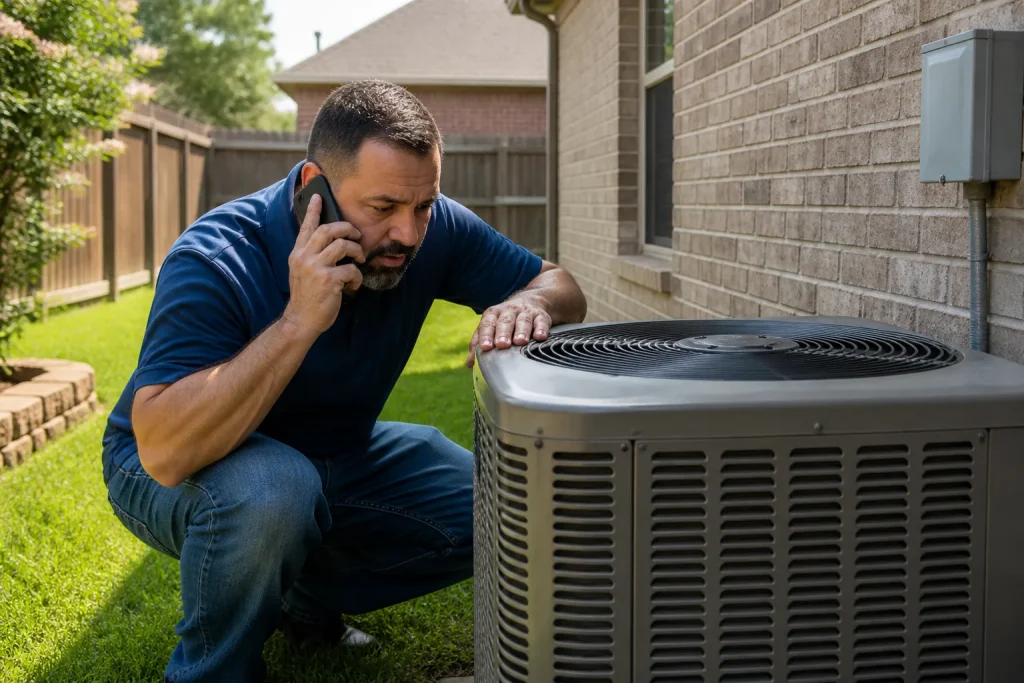
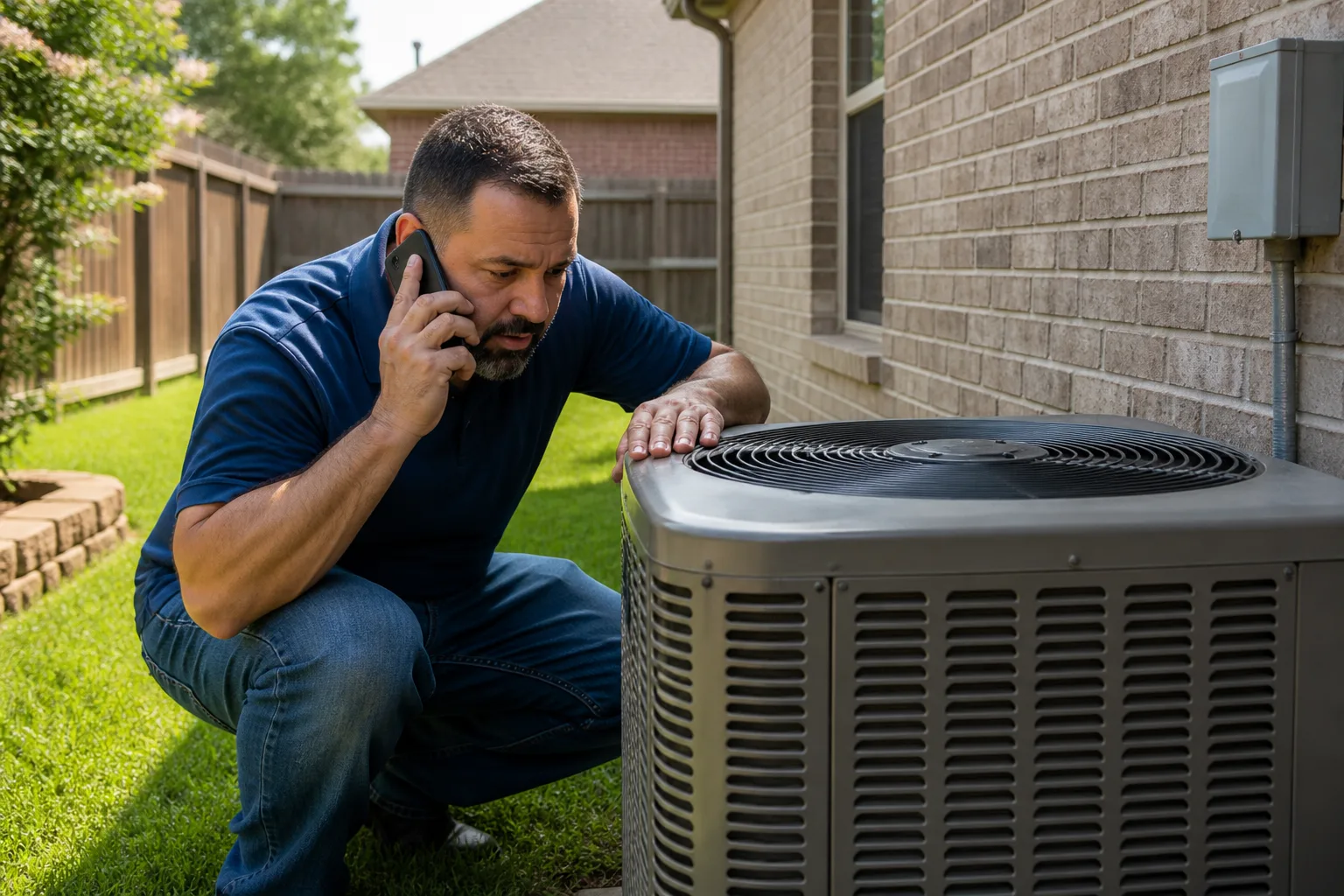
- Look at the outdoor unit. Walk outside and listen. Is the fan spinning? Is the compressor humming and then stopping? Is there ice on the copper lines? Is there debris packed against the coil? Note what you see and hear. You’ll repeat it to the technician, and it tells them a lot before they even pull up.
These four checks are safe to do without touching anything electrical beyond the breaker switch or anything mechanical beyond the filter. Anything past that belongs to a trained technician. In Irving, where summer heat loads a condenser hard for weeks at a stretch, a system that suddenly quits often has a simple cause sitting right in that list.
How Do You Keep the House Safe While You Wait?
Once you’ve called and have a technician scheduled, the waiting period matters. Make it work in your favor.
- Close off rooms you don’t use. Shut doors to unused bedrooms, storage rooms, and bathrooms. Cooling a smaller envelope with whatever air movement you can create is smarter than spreading your effort across the whole house.
- Place fans for cross-ventilation, not direct blast. Set a box fan in a window facing out on the hot side of the house, and another pulling in on the shaded side. Moving air through the space cools people faster than blowing warm air directly at them.
- Watch the indoor temperature. This is the part people skip. Once indoor readings reach the mid-90s, vulnerable members of the household, especially the elderly, infants, and anyone with a heart or respiratory condition, are at real risk. Move them to a cooler room, a neighbor’s house, or a public cooling space, and don’t wait for the house to get hotter before you decide.
- Keep blinds and curtains closed on the sun-facing side. It’s a small thing that buys a few degrees, and a few degrees matter when you’re waiting on a repair.
If you’re in a newer Irving subdivision with a tightly built house, the heat builds fast once the system is off. Older homes with more air leakage take longer but run hotter in the late afternoon. Either way, plan for the temperature to climb between when you call and when help arrives.
What Information Shortens Your Wait?
Have these details ready when you call, and the conversation moves faster and the technician arrives better prepared.
- Brand. Tell them whether it’s a Trane, Lennox, Goodman, Rheem, or another make. A shop that knows your brand sends the right person and brings the right parts. If your equipment is a Carrier, Bryant, or American Standard, Kingsley is set up for those too.
- Model and serial number location. On most outdoor condensers, the data plate is on the side panel. On indoor air handlers, look inside the cabinet door or on the blower housing. The model number is what identifies the equipment precisely.
- When the problem started. Did it quit during a cooling cycle? Overnight? After a power blink? Symptom onset tells a technician whether they’re dealing with an electrical fault, a refrigerant issue, or a control problem.
- Thermostat reading versus set point. “It’s 88 inside and set to 72” is a different picture than “it’s 74 and set to 72.” One means the system has stopped cooling; the other may mean it’s just struggling to keep up.
You shouldn’t have to explain your equipment to your technician. But having that information ready does shorten your call. It also lets the dispatcher route the right technician to you instead of sending someone who’ll spend the first twenty minutes walking around getting oriented.
How Do You Vet an Emergency HVAC Company Under Pressure?
When your house is hot and you’re calling the first company that answers, three questions tell you a lot about who you’re dealing with.
- Are you licensed and insured, and can you confirm it? A legitimate shop will confirm both without hesitation. An opportunistic day-of responder will dodge or get defensive.
- Are your technicians HVAC specialists, or do they work other trades too? A single-trade HVAC shop means every technician sent is an HVAC professional. A multi-trade outfit may have sent a plumber between calls. You want someone who works on cooling systems every day.
- Do you carry parts for my brand on your truck, or do you have to order? A shop that services nine major brands knows their parts inventory. A generalist may be learning your system on your dime.
Ask those three, and you’ll quickly sort licensed specialists from opportunists. Anyone pushing an immediate replacement before the system is even diagnosed should raise a flag. Diagnostics come first. We believe the right fix for your system is the one that the equipment actually needs, not the one that pays the best commission. Kingsley diagnoses first and recommends second. That standard holds whether you’re in Las Colinas or Valley Ranch.
Why You Shouldn’t Touch These Three Things
Homeowner instincts during a breakdown are usually wrong, and three common moves cause more damage than they fix.
- Don’t add refrigerant. Refrigerant is not like oil. You don’t top it off; a system that’s low has a leak somewhere, and adding refrigerant without finding and repairing that leak does nothing useful and can damage the compressor. It’s also a repair that legally requires a licensed technician.
- Don’t reset the system repeatedly. If it trips and stops, resetting it over and over won’t fix the underlying fault and can cause it to fail harder. Once is fine. After that, leave it off and let a technician look.
- Don’t cover the outdoor unit. People cover it thinking they’re shading the equipment or protecting it from sun. In fact, a cover traps heat and can push the compressor toward shutdown or worse. The outdoor unit is designed to sit in the heat. Let it breathe.
Past the breaker switch, the thermostat battery, and the filter, the rest of your system is not a DIY project. The refrigerant circuit and the electrical components run at dangerous pressures and voltages, and they belong to trained technicians. In Irving’s long cooling season, a small fault handled wrong in August can turn into a compressor failure by September.
When to Call a Pro
If the four-step triage doesn’t restore cooling, if the breaker trips a second time, if the outdoor unit hums but won’t start, or if the thermostat won’t respond after a battery change, it’s time to call. Those symptoms point to faults that need a trained eye and the right tools.
Same-day service is available. If it’s outside our dispatch hours, we answer 24/7. A call outside dispatch hours is booked into the next opening, Sunday through Friday, 7am to 7pm. We’re closed on Saturday, so a Friday-evening failure gets first priority on Sunday morning.
Related services in Irving: when trouble turns into a repair call, see AC repair. If the system is past its useful life, we’ll walk you through AC installation options honestly, including what a new unit costs and how long the changeover takes. We’re an HVAC specialist based in Irving, and heating is handled here too, so the relationship you build in August carries into furnace season.
Nine brands. One standard. That’s what we mean by the Kingsley standard, and it’s the bar every job is held to.
The Bottom Line
The four checks above are the difference between a frantic call and a prepared one. Run your breaker, thermostat battery, filter, and outdoor unit. Note what you find. Then call with your brand, model, symptoms, and thermostat reading in hand. Close off the house, move air, and watch the indoor temperature if anyone in the household is vulnerable. Skip the refrigerant and the reset button.
If you’re in Irving and need help, Kingsley AC Repair offers free estimates. Call (855) 473-9031. We answer 24/7, with fast dispatch from 7am to 7pm, Sunday through Friday. We’ve served Irving since 2014, working on nine major brands: Carrier, Trane, Lennox, Goodman, Rheem, York, Daikin, Bryant, and American Standard. We know your brand, so you’re not explaining it from scratch. Heating and cooling, handled.
Frequently Asked Questions
Call now. A failed AC in an Irving August is a heat-safety concern, not just an inconvenience, and the earlier a technician diagnoses the problem, the sooner it can be fixed. We answer 24/7, and calls outside dispatch hours book into the next opening, Sunday through Friday, 7am to 7pm. Call (855) 473-9031 for a free estimate.
If indoor temps climb toward the mid-90s, move the elderly, infants, and anyone with heart or respiratory conditions somewhere cooler. Don’t wait for the temperature to hit a specific number before you act. Use your judgment based on the people in the house, and call (855) 473-9031 to get help on the way.
For common parts on the nine brands we service, usually yes. For less-common parts, they may need to order. Calling with your brand and model number ready helps the dispatcher route the right technician and confirm what’s available. If you’re unsure of the model, we can help you find it at (855) 473-9031.
No. Refrigerant handling requires a license and the right tools, and adding it without finding the leak doesn’t fix the problem and can damage your compressor. Leave the refrigerant circuit to a trained technician. Call (855) 473-9031 for a free estimate and an honest diagnosis.
Written by the team at Kingsley AC Repair, serving Irving since 2014.
Need HVAC Help?
Call Kingsley AC Repair - licensed & insured, here with fast help in Irving.
(855) 473-9031