
Last updated November 14, 2026
 AC repair
 Furnace & heating
 Heat pumps
 Ductless mini splits
 Carrier
 Trane
 Goodman
Seasonal tune-up and full diagnostic on your Carrier, Trane, or Goodman system - readings shown to you before any repair is proposed
Diagnosis first, numbers second - you approve the repair price before a single part goes in.
Get your free estimateHVAC Cost Breakdown: The Irving Homeowner’s Reference for 2026
Two Irving homeowners replace the same 3-ton system in the same month. One quote comes in at $6,800. The other comes in at $10,900. It’s tempting to assume the higher bid is padding its margin. Usually it isn’t. The gap is scope: one quote includes duct modification, a mechanical permit, equipment registration, and haul-away; the other leaves those line items out and hopes nobody asks. What separates a fair HVAC price in Irving from a misleading one isn’t the total at the bottom. It’s what’s listed above it. This guide opens up the bill: equipment tier, labor, refrigerant, permits, disposal, and the ductwork question almost every Irving home runs into. You’ll learn how to compare bids line by line and where the real ten-year cost lives.
Quick Answer
A full HVAC system replacement in Irving, Texas, typically runs between $6,500 and $13,500 in 2026, with most single-family home replacements landing in the $7,500 to $10,500 range. That spread comes from four variables: equipment brand tier, system size, ductwork condition, and how much of the job (permit, disposal, registration, refrigerant) is spelled out in the written estimate. Repair work is priced per job by written estimate, and we provide free estimates so you can see the line items before you commit.
Styles & brands we work with
- AC repair
- Furnace & heating
- Heat pumps
- Ductless mini splits
- Carrier
- Trane
- Goodman
Table of Contents
- What’s Actually on an HVAC Replacement Quote in Irving?
- Does Brand Tier Change the 10-Year Cost?
- What Does the Ductwork Variable Cost in Irving Homes?
- How Do You Run the Repair vs. Replace Math for Irving’s Climate?
- How Do You Compare Quotes Without Getting Burned?
- What Do Common AC Repairs Cost in Irving?
- What About Furnace Repair Costs in Irving?
- When Should You Schedule Replacement Work?
What’s Actually on an HVAC Replacement Quote in Irving?
A full replacement quote should break into six categories, and every one of them needs a number. When you see a single lump-sum total, ask for the breakdown. Any contractor who won’t provide one is telling you something important about how they operate.
The six line items on a properly itemized Irving replacement:
- Equipment. The condenser, air handler or furnace, coil, and any line-set components. This is the largest single number and the one most affected by brand tier.
- Labor. Removal of the old system, installation of the new, connection of electrical and refrigerant lines, and startup. Varies with access (attic vs. closet vs. garage) and system size.
- Refrigerant charge. Included with new equipment, but ask specifically. Some quotes list refrigerant as a separate line, which is fine as long as it’s transparent.
- Permits. The City of Irving requires a mechanical permit for HVAC replacement. Permit cost varies by job, but it should appear on the quote. If it doesn’t, either the contractor is pulling it and burying the fee inside another line, or they aren’t pulling it at all. Unpermitted work causes problems at resale.
- Disposal and haul-away. The old condenser and air handler have to go somewhere. Ask who handles removal and whether a disposal fee is included.
- Duct modification. This is the wild card. See the next section.
Optional line items – a new thermostat, a condensate pump upgrade, a return-air plenum modification – should be listed separately and clearly marked optional. Not everything on a quote is mandatory. A written estimate that separates “required for the install” from “recommended” is a professional estimate. One that bundles everything into one number and shrugs when you ask is not.
We’re a specialist shop, not a general contractor. Our work on an Irving system is AC installation and repair, nothing else. That focus is intentional – it means the person at your door is an HVAC technician, not a multi-trade handyman who did an HVAC call last Tuesday.
Does Brand Tier Change the 10-Year Cost?
Yes, and not in the way most homeowners expect. Every major manufacturer sells three tiers – good, better, best – within the same brand name. A “Trane system” is not one price. It’s a range. The same is true for Lennox, Goodman, Rheem, and the rest.
Here’s how the tiers differ in practical terms:
- Good tier (base models). Single-stage compressor, standard efficiency, basic controls. Lowest sticker price. Longest history of proven reliability because the design is simple. Highest run cost over ten years.
- Better tier (mid-range). Two-stage compressor or variable-speed air handler, higher efficiency ratings, quieter operation. Sticker price lands in the middle. Run cost drops noticeably over a decade of Irving summers.
- Best tier (premium). Variable-speed compressors, communicating controls, the highest efficiency specs. Highest sticker price. Lowest run cost, most comfort, most complex electronics.
The reason this matters in Irving specifically: cooling season is long and hot. A system here runs more hours per year than one in a cooler climate. That means the efficiency gap between base and mid-tier models translates into a larger lifetime energy difference than it would in, say, a northern city. We’ve seen the same pattern in every Irving neighborhood we work in, from Las Colinas to Valley Ranch: the run cost, not the upfront price, separates a $6,800 system from a $9,200 system over a decade.
Our recommendation is usually mid-tier for a homeowner planning to stay ten years or more. Base tier makes sense for a short-hold property or a tight budget. Premium tier makes sense when comfort and quiet matter more than the upfront hit. The right answer depends on your situation, not on which manufacturer wants our referral. Our recommendations are brand-neutral by design.
What Does the Ductwork Variable Cost in Irving Homes?
Replacing a system without assessing the ducts is like replacing an engine without checking the transmission. If the existing ductwork can’t handle the new system’s airflow, the equipment won’t perform to spec no matter how good it is. This is where a chunk of that $4,000 gap between Irving quotes usually lives.
Here’s how to assess compatibility before you commit:
- Ask for a static pressure reading. A properly trained technician can measure whether the existing ducts can move the required airflow. High static pressure means the system is working hard against a restriction. If a contractor doesn’t measure, ask why not.
- Check the return air capacity. Undersized returns are the single most common duct problem in older Irving construction. A system that can’t breathe returns poor comfort and short equipment life.
- Inspect for disconnected, crushed, or unsealed runs. Attic duct runs in Texas heat take a beating. Leaks waste cooling capacity and pull attic air into the system.
- Verify the duct material. Flexible duct is common and fine when properly sized. Poorly installed flex with sharp bends or sagging runs is a performance killer.
- Ask about the register count. If a previous owner added a room without adding a supply, the system may be undersized for the house it’s now serving.
Remediation costs depend on the scope. Sealing and rebalancing is the lowest-cost tier. Replacing a run or two of flex is the middle. A full duct redesign or replacement is the highest. That last category is where the biggest dollars live, and it’s also the line item the cheapest quote tends to omit. If the system you’re installing needs more airflow than the existing ducts can deliver, skipping the duct line isn’t saving you money. It’s moving the cost to a warranty call two years later.
We service nine major brands – Carrier, Trane, Lennox, Goodman, Rheem, York, Daikin, Bryant, and American Standard – and the duct question comes up on every one of them. Nine brands, one standard: the ducts get assessed before the equipment goes in.
How Do You Run the Repair vs. Replace Math for Irving’s Climate?
The standard industry rule of thumb – replace if the repair costs more than one-third of a new system – is a starting point, not a formula. Irving’s long cooling season makes a more specific calculation worth running. Here’s how we frame it for homeowners who are on the fence.
The break-even formula in plain terms:
- Estimate the annual run cost of your current system. Take the system’s BTUs, divide by its seasonal efficiency rating, multiply by your usage hours, and multiply by your electric rate. Most homeowners can approximate this from a summer month bill.
- Estimate the annual run cost of a new system at your chosen tier. The efficiency difference between your existing equipment and a mid-tier replacement translates directly into a dollar difference.
- Add expected repair costs over five years. An aging system at 15 years is likely to need a repair every year or two. The average repair cost times the expected number of repairs is your five-year repair exposure.
- Compare that five-year total to the installed cost of a new system. If repairs plus run cost over five years approach the installed cost, replacement wins.
The Irving-specific twist: because cooling season runs longer here than in most of the country, run-cost savings accumulate faster than the generic calculators assume. A system with a meaningful efficiency gap pays back faster in Irving. That said, the math only holds if the equipment is properly sized. Oversized equipment short-cycles, and short-cycling kills efficiency gains. This is why a proper load calculation matters more than the brand sticker.
If your current system is under 10 years old and has a single repair needed, repair is almost always the right call. If it’s over 15, has had two or more repairs in the last three years, and shows other signs of aging (rising bills, uneven comfort, longer run times), replacement is usually the more honest answer. We’ll tell you which one applies to your system, not which one pays us more.
How Do You Compare Quotes Without Getting Burned?
Two bids are only comparable if they cover the same scope. Most Irving homeowners compare the bottom-line number and stop there. That’s where the surprises start. Use this checklist to normalize every quote you receive.
Scope-verification checklist for Irving HVAC replacement bids:
- Is the equipment model number listed, not just the brand name? A quote that says “Trane 3-ton” tells you nothing. A quote that lists the specific model number lets you verify the tier.
- Is the SEER2 or HSPF2 rating specified? The efficiency rating tells you which tier you’re actually getting.
- Is the permit fee line-itemed, or explicitly stated as included? If neither, ask directly.
- Is duct modification assessed, quoted separately, or excluded with a note? “No duct work needed” is a legitimate answer only after assessment.
- Is equipment registration handled by the contractor, or is it the homeowner’s responsibility? Manufacturer warranties depend on timely registration in most cases.
- Is haul-away and disposal included?
- Is the thermostat included, and if so which model?
- Is the labor warranty spelled out in writing?
- Does the quote include a manual J load calculation or just a rule-of-thumb sizing? A proper load calc accounts for house envelope, window orientation, insulation, and local design temperature.
- Is the quote itemized, or one lump sum? An itemized written estimate is the baseline expectation.
A quote that omits half of these items isn’t cheaper. It’s incomplete. Put both quotes side by side and add the missing line items back in. The real totals usually converge – and when they don’t, the lower one is missing something you’ll end up paying for later.
What Do Common AC Repairs Cost in Irving?
Repair pricing is set per job by the written estimate. What we can give you is the relative cost of each common repair, because understanding which repairs are cheap and which ones approach replacement territory helps you make better decisions in the moment.
Common AC repairs we see in Irving, sorted by typical cost band:
- Capacitor replacement. Lowest-cost repair band. A failed run capacitor is one of the most common summer failures. Fast, straightforward fix.
- Contactor replacement. Similar band to a capacitor. Another common electrical failure on aging equipment.
- Blower motor replacement. Middle cost band. The motor itself plus labor. Common in systems over 10 years old.
- Condenser fan motor replacement. Middle cost band. Similar to blower motor in scope and labor.
- Refrigerant leak detection and recharge. Varies widely by leak location. A small leak at a service valve is one thing; a leak in the evaporator coil is another entirely.
- Evaporator or condenser coil replacement. Higher cost band. Approaches the threshold where replacement math starts to matter.
- Compressor replacement. Highest repair band. Often the point where a homeowner should run the full repair-vs-replace equation before committing.
We know the equipment. Our whole reason for narrowing our service menu to AC repair, AC installation, and furnace repair is that depth beats breadth on this work. When you call us, the technician at your door works on your brand of equipment every week – not once a quarter between plumbing and electrical jobs. We cover nine brands across the industry for exactly this reason: Carrier, Trane, Lennox, Goodman, Rheem, York, Daikin, Bryant, and American Standard.
What About Furnace Repair Costs in Irving?
Irving winters are mild, but they’re not nothing. A failed furnace in January matters, and the cost of getting it fixed runs on the same principles as the AC side: pricing is per job by written estimate, and the estimate is free.
The most common furnace repairs in this market:
- Ignitor replacement. The hot-surface igniter is a wear item and fails with some regularity. Relatively quick fix.
- Flame sensor cleaning or replacement. A fouled flame sensor causes short-cycle lockouts. Common, simple repair.
- Pressure switch failure. Frequently caused by a blocked vent or condensate issue. Diagnosis matters as much as the part.
- Inducer motor replacement. Middle cost band. The motor pulls combustion air through the system; when it fails, the furnace won’t run safely.
- Heat exchanger assessment. If the heat exchanger is compromised, that’s a safety issue that can change the repair-vs-replace math entirely. This is not a repair to defer.
One thing worth flagging on the heating side: gas furnace work involves combustion and venting, and it’s not a do-it-yourself category. A technician has to verify combustion safety, venting, and gas pressure with instruments. If a furnace smells like gas or the carbon monoxide alarm has gone off, leave the house and call from outside – that’s not a repair call, that’s a safety response.
When Should You Schedule Replacement Work?
Replacement work is scheduled, not same-day. A system replacement requires a load calculation, equipment selection and ordering, permit pulling, and a scheduled install window. Rushing that sequence is how corners get cut. So the timing question is less about urgency and more about planning ahead so the work happens on your terms rather than in a scramble.
In Irving, the practical planning calendar looks like this:
- Spring is the ideal replacement window. The old system hasn’t yet been pushed through a full season, and the new system goes in before the heat arrives.
- Fall is the second-best window. Cooling season is winding down, and the replacement system is ready for both winter and the next summer.
- Peak summer is when a planned replacement often turns into an emergency replacement, and when equipment availability tightens. If your system is on its last legs, don’t wait for it to fail in July.
When we quote a replacement, you get a written fixed price, a set install date, and we handle the paperwork – permit application, equipment registration, and confirming manufacturer warranty requirements. No surprises at invoice time.
Common Mistakes to Avoid
- Comparing only the bottom-line number. Two quotes for the same home can differ by thousands, and the difference is almost always scope. Itemize both before deciding. The lower bid is often just the one missing a duct line.
- Accepting a quote without a model number. “Trane 3-ton” could be a base-tier unit or a premium variable-speed system. Both have the Trane sticker. Only the model number tells you which one you’re getting.
- Skipping the load calculation. Sizing by square footage alone is a shortcut that costs comfort and efficiency. Irving homes vary widely in envelope and window orientation – Las Colinas condos, Valley Ranch mid-century homes, and newer construction in the Las Colinas Urban Center all need different load calcs.
- Assuming no permit is needed. The City of Irving requires a mechanical permit for HVAC replacement. If your contractor doesn’t pull one, that becomes your problem at resale. Ask for the permit number.
- Ignoring duct condition. Replacing equipment on failing ducts is one of the most common cost mistakes we see. The new equipment underperforms the spec sheet, and the homeowner blames the brand.
- Assuming repair is always the cheaper call. Short-term, yes. Long-term, a 16-year-old system with two repairs already logged in the last year is often more expensive to keep than to replace. Run the math rather than the reflex.
- Forgetting equipment registration. Manufacturer warranties on equipment usually depend on timely registration. If your contractor handles registration, confirm it in writing. If you’re handling it, do it the day after installation.
See the difference
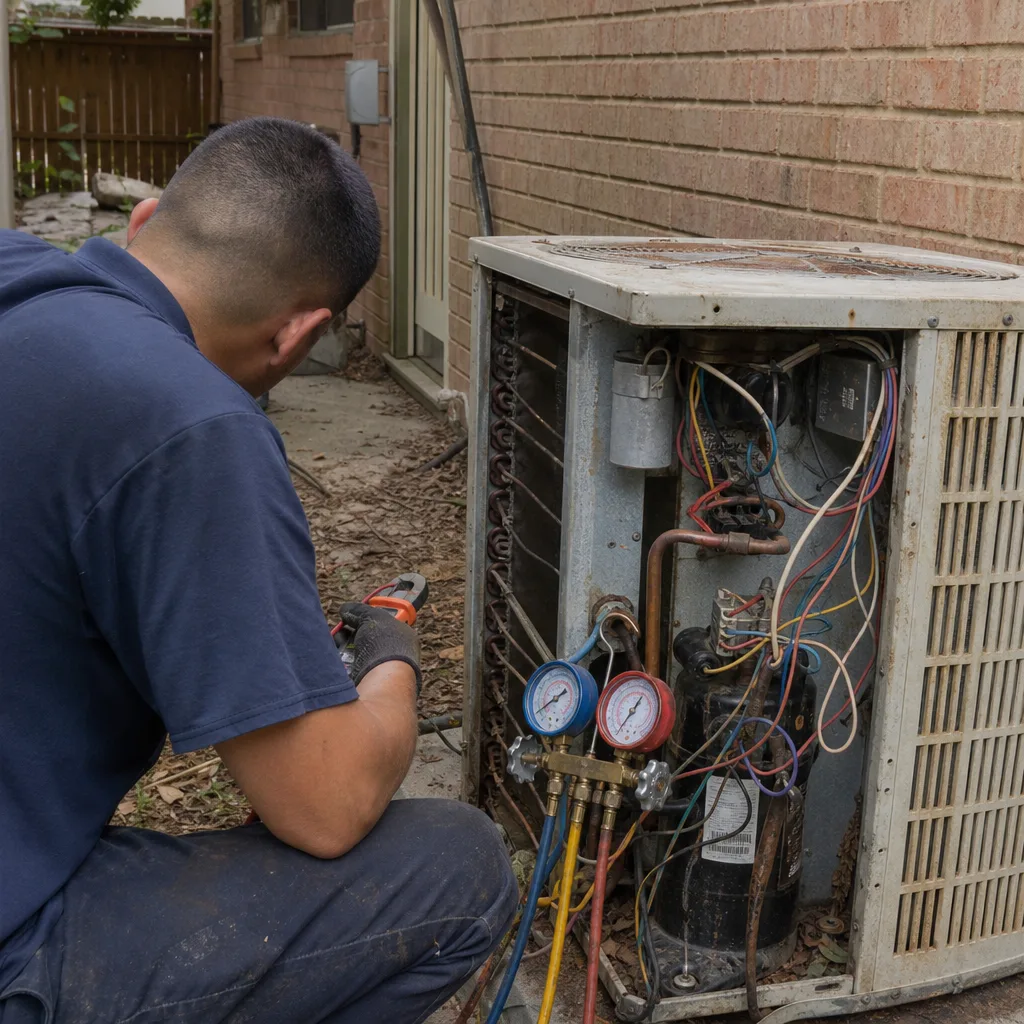 Before
 After
 Before
 After
 Before
 After
When to Call a Professional
Call a professional when the system is blowing warm air, when the compressor or fan won’t start, when the furnace isn’t igniting, or when ice or frost is forming on the refrigerant lines. Call also when you smell gas or your carbon monoxide alarm sounds – that’s a safety call, not a repair call, and everyone should be out of the house first. Call if your system has needed two or more repairs in the last year, if it’s over 15 years old and showing stress, or if your summer bills are climbing without any change in usage. Call when you’re comparison-shopping replacement quotes and want an itemized written estimate you can line up against the others. And call if something on your current quote doesn’t add up – a free second opinion on the scope is worth more than the time it takes to get it.
Kingsley AC Repair offers free estimates in Irving. AC repair is our daytime bread and butter, and we handle heating under the same roof. Call (855) 473-9031. We answer 24/7. Fast dispatch from 7am to 7pm, Sunday through Friday.
Frequently Asked Questions
Most single-family system replacements in Irving run between $6,500 and $13,500, with the middle of the market clustering between $7,500 and $10,500. The spread comes from equipment tier, system size, ductwork condition, and how many line items the quote itemizes versus omits. Permit fees, disposal, equipment registration, and duct modification are the items most commonly excluded from low bids – and the reason two quotes for the same job can be thousands apart. Call (855) 473-9031 for a free written estimate – the line items, not just the total.
Yes. The City of Irving requires a mechanical permit for HVAC system replacement. The permit fee is typically a modest portion of the total project cost, but it should appear as a line item on your written quote. If a contractor says no permit is required, ask for that in writing before you sign. Unpermitted replacement work causes problems at resale and can void coverage in some circumstances. Call (855) 473-9031 if you want a quote that itemizes the permit line clearly.
Repair makes sense when the system is under 10 years old and has a single repair need. Replace when the system is over 15, has needed two or more repairs in the last year, shows rising run costs, or the cost of the repair approaches the installed cost of a new system. In Irving’s long cooling season, the efficiency gain on a new system pays back faster than the generic national calculators assume – so the replacement math tilts toward replace more often here than it does in milder climates. Call (855) 473-9031 for a straight answer on your specific system.
Yes, and more so than in most cities. Irving’s long cooling season means the system runs more hours per year than a comparable system in a cooler climate. That amplifies the annual energy difference between a base-tier unit and a mid-tier unit. The upfront sticker price gap between tiers is fixed, but the run-cost gap compounds year over year over a decade. Call (855) 473-9031 and we’ll run the numbers for your home size and usage, so you can see the actual ten-year math rather than an industry average.
We’re trained and equipped to service nine leading manufacturers: Carrier, Trane, Lennox, Goodman, Rheem, York, Daikin, Bryant, and American Standard. If you already own equipment from one of those brands, we know that equipment. Our recommendations on repair or replacement are driven by what the system needs and what your situation calls for, not by which manufacturer we’re aligned with. That’s why we work across multiple brands rather than pushing one. Call (855) 473-9031 to talk through options for your specific system.
A typical single-system replacement is a full-day job, sometimes two, depending on access, ductwork scope, and whether any electrical or refrigerant line work is needed. It’s scheduled work, not same-day – the process starts with a load calculation, equipment selection, permit application, and a scheduled install date. You’ll get a written fixed price and a confirmed install date before we order equipment. Call (855) 473-9031 to start the process. We answer 24/7. Fast dispatch from 7am to 7pm, Sunday through Friday.
The Bottom Line
HVAC pricing in Irving isn’t a single number. It’s a stack of decisions: equipment tier, load-calculated system size, duct condition, permit, disposal, and the discipline of the contractor writing the quote. The right questions are: is it itemized, is the model number listed, is the permit line visible, was the ductwork assessed, and did the contractor run a load calculation? Those answers tell you whether the number on the page is real. We run a specialized shop on purpose. Our work is heating and cooling, held to the Kingsley standard, across nine brands. Heating and cooling, handled.
If you’d like to see what a properly itemized estimate looks like for your home, call Kingsley AC Repair. Free estimates, straight answers, no pressure to replace when repair is the right call.
Call (855) 473-9031 for a free estimate. We answer 24/7. Fast dispatch from 7am to 7pm, Sunday through Friday.
Written by the team at Kingsley AC Repair, serving Irving since 2014.